Monday, 11 February 2013

The Big Wedgie

This is just a short blog about an interesting development in the Arctic. I keep a frequent lookout on websites such as NSIDC's Arctic Sea Ice News and importantly Neven's Sea Ice Blog.

One of the big predictions for forthcoming years is the collapse of the Arctic ice cap which may happen as soon as in just a few years. This graph makes it quite clear what will happen:
It's a scary graph and implies that we'll have a September minimum of 0Km3 as early as 2015; an August ... October minimum of 0Km3 as early as 2016 and a July minimum of 0Km3 as early as 2017. That is, a rapid collapse of the Arctic sea ice. However, there are wide error bars, and so future predictions should be treated cautiously.

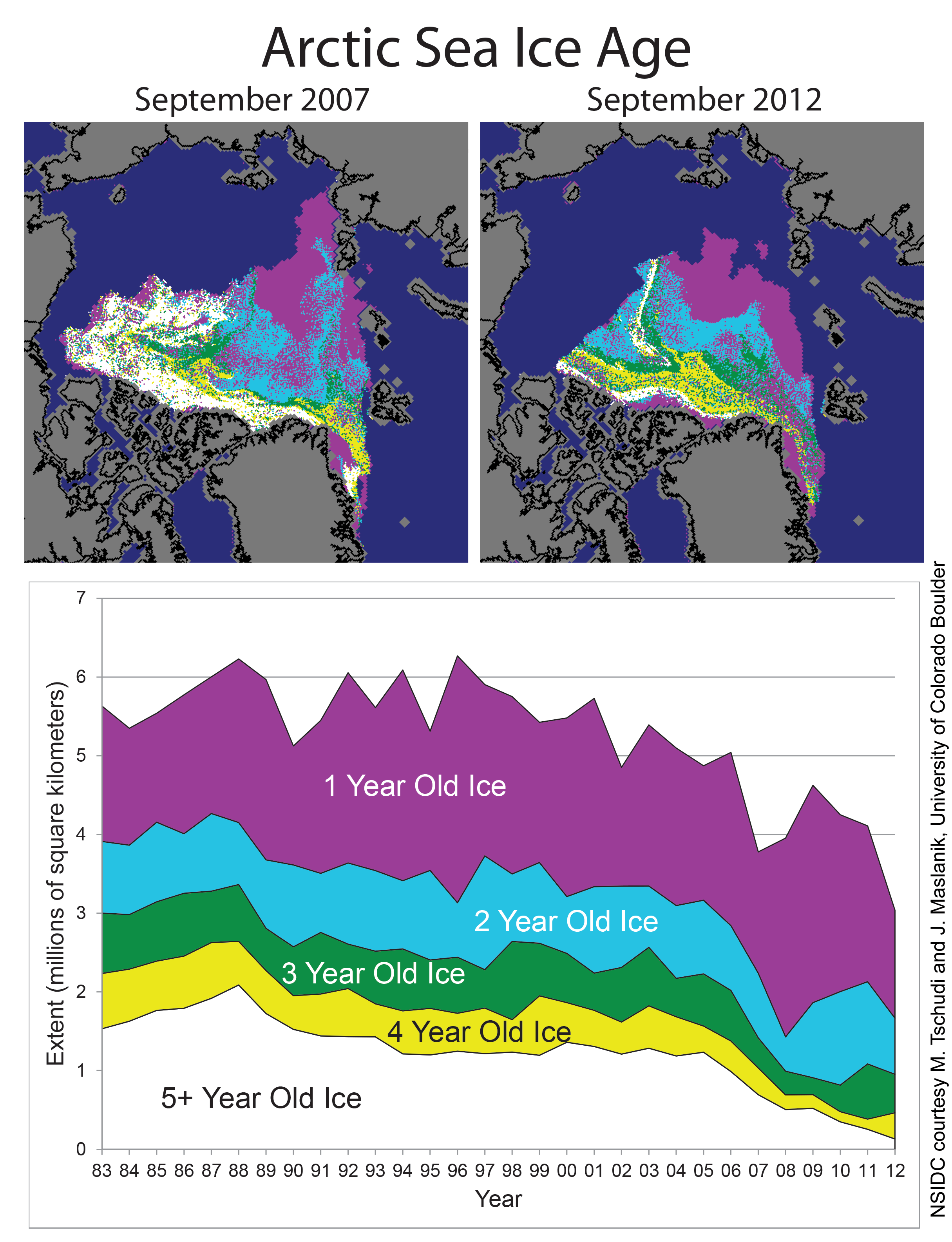
In the arctic much of the ice disappears every year (first year ice), but some remains (multiyear ice). The resilience of Arctic sea ice depends upon multi-year ice, because it's thicker. Most of the multiyear ice was lost in 2007 and has progressively depleted since then.


As you can see, most of the remaining multi-year ice (about 20% of ice >=4 years) clings to the North Coast of Greenland and islands North of Canada and the thinking is that any ice that clings on beyond 2016 or so will be there. This might not happen. Here's why. There's regular arctic ice being churned out from the Fram Strait, the sea between Greenland and Svalbard thanks to Arctic ocean currents that head up North round  from the Atlantic (the same currents that give the UK warm weather).  You can see it here:

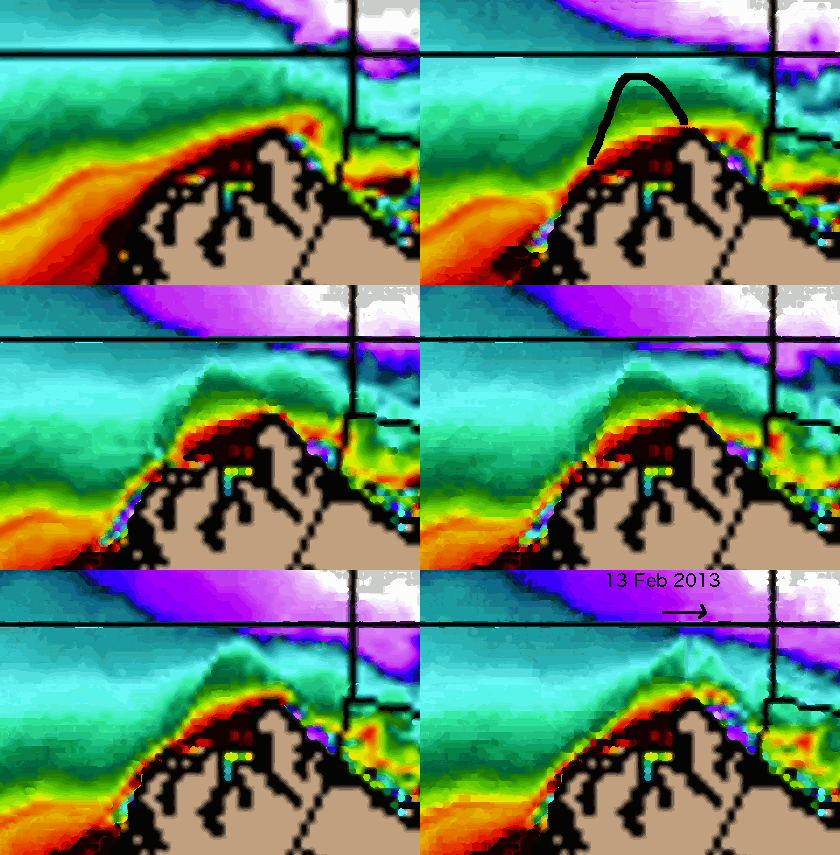
It's thought by some Arctic observers that the multi-year ice is held in place at the top of Greenland by what's called the Wedge. This may get swept out through the Fram strait in just a couple of days. It'd be the big Wedgie for the Arctic and would have serious consequences for the remaining multi-year ice and whether the Arctic sea ice would in fact trend to around 1MKm3 or nothing at all. Here's a model of the process:

The reason why it can get swept out now, is because the ice is so thin elsewhere in the Arctic, on average, it's just over 1metre thick. Since we know that with thinner ice sea currents have more opportunity to influence Arctic sea ice and in recent weeks observers have noticed a number of cracks appearing in the Arctic sea ice, early than they would be expected (large cracks do occur in the ice, just not normally this early, here):
(It's a false-color image so you can see the contrast more easily, Greenland is bottom right, cracks are shown white against orange).
Of course, it might not actually happen - I'll post a comment in a few days if it does!

Friday, 23 November 2012

National Lottery: A Government Wealth Warning

I just met a guy buying a lottery ticket at a local mini supermarket I tried to talk him out of it, but it didn't work - he thinks he has lucky gypsy genes in him :-s . There must be ways of putting people off buying lottery tickets. At the very least I figure every lottery ticket should be a bit more honest and carry a government wealth warning. Something along the lines of:

"Play every week for 50,000 years and odds are: You'll win!"

 Well, it's the truth, (1-1/14million)^(52*50000) just lowers the chances of you losing to under 0.5. Actually, I just checked and it's not the truth, you really need to play for around 190,000 years.

Another way of looking at the National Lottery is that it's a tax on the less well off. To quote from the article 14% of the population play the lottery, but it's 36% of the less well-off (those earning < £20,000). Since those earning under £20K represent 50% of the population, that 36% represents pretty much every lottery player. Which gives plenty of scope for other warnings:

"Help fund the causes of richer people than you! Play the lottery Now!"

By and large that'd be true too. Simply at the level of not playing you benefit more in lottery-funded government initiatives and since I've never played it, I've benefited by roughly £14million*0.3*52*(2012-1994)/60million = £65 since its inception :-) Woohoo this leads me to my third warning!

"Don't play the Lottery and WIN EVERY WEEK!"

 I can't argue with that, but then I had a better idea. Why not get the top 25% of the population to pay for the lottery? This is how it'd work, the top 25% are taxed an extra £4 every week - no sweat, they can easily cope - and anyone who wants a lottery ticket can have a single ticket for free! Then the same rules apply for winnings, depending on how many numbers you get right and the other aspects such as government income and charity funding works as before. Brilliant, and all the money flows in the right direction! Best of all, it's no longer even gambling since you're not actually risking any money to gain a return!

What do you think? I think I'll call it, the Rational Lottery.

Monday, 24 September 2012

An iPod mini Adventure

Remember the old black and white iPod generations? Well, yesterday I retreived my long-lost first-generation iPod mini and it thrilled me to bits!

The iPod mini was the shortest-lived iPod and somewhat derided on introduction as being over-priced and kinda girly. It turned out to be so stunningly popular Apple had difficulty meeting demand. I ordered mine just two hours after they became available in the UK Apple Store in June 2005.

You'd think their internal 1.4" spinning hard disk would make them pretty delicate, but in fact that they could take real abuse and my iPod mini's no exception:


It's a battered little critter, mostly from being driven over for a few hours in a Stockport car park where I once accidently dropped it. Chunky isn't it - they made electronics that way then ;-)

Yet two years ago I managed to leave it on holiday at Dove farm cottages in Ellestone with my fiancée and some friends. I'd kept trying to make an effort to track it down since then, but after a little autumn camping trip at the wonderful, good-value and basic Pudding Room campsite with a couple of friends this weekend:

I thought I'd have make a real effort to find it. So I headed off back to Dove Farm and had to knock a couple of times before a lady opened the door (they weren't expecting me, 'natch). So I cautiously asked whether they remembered seeing an old iPod mini left here back in 2010.

“That’s a long time ago”, she said.

I understand, I said as I described it, It’s a bit of a long-shot, enough of one to have made a personal point of giving it back to God a few minutes before.

“But if it's there, I think I know where it'll be.” and she headed off back into the house. I thought she was going to head off to the dining hall where we'd actually played iPod music during the holiday, but actually she returned just a minute later with it exactly as I'd left it. Rather than chucking it all, they have a bit of a stash of things guests have left behind, which is impressive considering how often people are likely to do that.

Speaks volumes about Dove farm, thank you.

I charged it up last night and I've been listening happily to its contents this morning, batteries are still good after all these years :-D

Thursday, 13 September 2012

SIA Later!

Or rather we won't as in a few years it'll all be gone!

This is a little blog about current Arctic Sea Ice Area as we near the 2012 record-breaking summer minimum.

Take a look at the image:

It's a section of the Arctic SIA as of yesterday.

We can see that the whole of the top-right hand edge, is the Northern Sea Route. You can see it's open-water and there's a lot of it. It first opened in 2009, but right now it's so wide you could pretty much sail the UK straight through; and within 3 years!

The opening of the Northern Sea Route means that ocean currents can sweep more easily round the eastern edge of the North Pole; bringing warmer waters from the Gulf Stream (not to be confused with the Jet Stream); and thus accelerating the collapse of the Arctic Sea Ice. We can see the effect quite clearly; the eastern edge continues to melt significantly, just days away from the supposed end of the melting season.

By contrast the Western edge of the Arctic Sea Ice is pinned by an extensive set of islands as well as the all-important Greenland land mass. This is why the Sea Ice is clinging to that edge, the frozen land keeps it cooler and protects it from ocean currents.

The last thing to note is the colour scheme. Red means '60%' ice, pink means '80%' ice; purple is near 100%. This means that the white dot in the middle, which is the North Pole itself, is only 80% Sea Ice at best and has a large amount of 60% (i.e. rotten) Sea Ice relatively close by. Given that the Eastern edge of the ice is about half-way to the North Pole, I'd guess it'll be gone within 3 years.

SIA Later, in a week or so for my post on the Arctic minimum!

Friday, 3 August 2012

Horses That Run...

...are the ones that aren't starved.

The BBC recently linked to an article on PowerPoint's 25th anniversary. I'd always thought it was a Windows app until now, but actually it was Mac about 6 years before it made it to Windows. Suddenly that made Powerpoint about 10x more interesting than I'd ever considered so I did a bit of searching and found a book called Sweating Bullets.

The free google book edition leaves out quite a bit, but I was mostly interested in the history up until the first release: the kind of development difficulties Forethought had working on early Macs (they targetted the 512Kb Mac) and the online book covers that quite nicely.

Actually most of the book is about the marketing of Powerpoint: why the concept was such a hard sell and Robert Gaskins, the project manager, deserves a lot of credit for his persistence. But the thing I found most interesting was their whole perspective on the development platform.

This is how it goes. They started work on Powerpoint in late 1984 / early 1985 after spending 18 wasted months working on a PC-based graphical predecessor that included an operating system (because graphics OSs weren't really available by then). Now, Windows 1.0 had kinda just been released, but the Mac had been around for 18 months. However, Gaskins initially discounted the Mac version and planned all the design and development for Windows. It was only when he found out that the current state of Windows in 1985 was:
  1. Unusable, and
  2. Years away from being useful (in fact, about 6 years, but they didn't know that then); and
  3. Not even Microsoft were planning to release practical graphical apps for Windows until years after their Mac versions of e.g. Word and Excel.
That they decided (grudgingly) to go with the Mac version first. When they did, they found that with the exception of having to run the development tools on Lisa its predecessor, not only was the Mac wonderful to use even in 1985, but that its design gave it ample performance and software components to complete both the first plus second versions of Powerpoint with less than 1/3 of the effort it took to merely port it to Windows when that day finally came.

What this really shows is how mindshare affects business decisions; in this case Windows had already won in the minds of software developers even though it was a complete train crash at the time - the quality and capability of an existing competitor wasn't even a consideration until the alternative was known to be infeasible.. and even then the Mac version (that saved their company) was really only developed in order to springboard their way to Windows.

It's not the way I think, I'd sooner plug quality and good ideas even if they're not going to be the obvious winners - after all, any horse can win if you starve the rest - it's just not something to be proud of. So it's not surprising then that Apple found it so hard to make headway for the first 20 years and being caught out by the Windows mindshare effect in this case was a real surprise for me!

Friday, 6 July 2012

Are They Human, or Are They Bankers?

Tony Robinson raised that question on Question Time last week. Although he gets a couple of facts wrong (e.g. bailouts were billions, not millions) his stinging litany of Bankers' greed leading up to 2008 and the aftermath makes for sober listening.

However, the latest scandal involving Barclays Libor rates appears to have the previous Labour Government possibly implicated. Based on the evidence I can muster though I don't think that really makes sense. Here's why:

Banks make short-term (daily-ish) loans to each other to cover short-falls in each others' reserves. The largest 8 banks publish the rates they have to pay when they take a loan of this kind and the middle 6 are used to derive what is called the Libor rate. The scandal is that Barclays' fiddled their published Libor rate after late October 2008 to, 2010 (or was it 2009)?

However, Barclays now claim that they only manipulated it because they'd heard that senior Whitehall figures were concerned about their Libor rate being in the top quartile or decile. This is how the history pans out:

Before October 8, 2008

This Guardian article gives the sequence of events, but you'll need to start at the bottom. HBOS crashes 34% on Sep 15 as Lehman Brothers employees are turfed out of Canary Wharf. Barclays seals deal Lehman assets on Sep 16 while HBOS shares crash to 88p. Sep 17, Libor hits a 7-year high; Lloyd takes over HBOS for £12.2bn while Morgan Stanley crashes 30% (and turns into a non-investment bank 5 days later). Sep 25: Bradford & Bingley let go of 350 staff (later bought by Santander) and HBSC axes 500 a day later. By Sep 29, RBS are down 20% Barclays another 9% and Libor goes 'through the roof'. Just before October 8, Icesave goes into default and then the UK government announce their rescue package.

Barclays Libor During The Rescue Package

The UK Government's bank rescue package provided £500bn for a number of major banks and of the major ones, only Barclays declined to get involved, despite them having shrunk pretty much as much as Lloyds.


 Barclays needed a cash injection of 6.5bn, but they chose to get it privately. Now, if we switch to looking at their Libor graph over the period:
 To my mind the first oddity is that their Libor had been rising in Mid-september, but goes lower at the point where they decide to buy Lehman Bros assets before shooting back up by about the 20th. I'm not sure if that makes complete sense. The Libor rate reflects the insecurity of the bank - why would it go down if they buy the assets of a bankrupt company?


Their Libor then climbs sharply (along with other banks) through to the bailout on October 8; drops briefly and then continues to rise to the end of October. Now, I would be pretty sure that there would be civil servants in Whitehall who would be monitoring the Libor of particular banks - because given their prior financing behaviour, it would not be unexpected for them to engage in financial cover-ups. Barclays figured it needed a small fraction of other major banks (6.5bn), but would finance it privately so it was claiming it's finances were secure. However, their increasing Libor implies they aren't.


The question is, does it make sense for Labour to push Barclays into artificially lowering its Libor rate given that it was willing to bailout Barclays a month before (Barclays 6.5bn would have been 1.2% of the overall bailout)? My thinking is it wouldn't make sense: it'd make more sense for Labour to push Barclays into joining the bailout.


On the other hand, would it make sense for Barclays to not want the UK government (and by that token the UK tax-payer) to part-own Barclays? Yes, that would make sense.


Would it make sense for Whitehall to be concerned about Barclays Libor figures? Yes, given the financial situation at the time, yes it'd make sense.


One further thing to note; by artificially lowering Barclays Libor rate to a negative one, doesn't that mean that Barclays would be effectively gaining money on inter-bank lending? Money that had come from the UK government bailout? At the time, note that Barclays justified its financial security by arguing that it would raise £7.3bn via its Middle East investments (Guardian, October 31, 2008), but its Libor rate had started falling 2 days before.


Friday, 1 June 2012

Global Crunch Twin Pack

Most of my blogs are techie, but occasionally I stray into politics. It looks like the global economy is about to take a second bite at the same, un-nutritious Global Crunch candy bar, I don't think it has to happen.

In 2008 I wrote a post about the Global Economy Crunch. In it I compared it with previous major economic collapses. My assessment at the time meant I connected those crashes with an unsustainable boom due to market deregulation and the following depressions due to protectionist (i.e. austerity) measures and only overcome due to practical implementations of Keynsian economic theory. I predicted that this crash would last at least as long as the worst of the previous ones.

Since then, although we managed to avoid a meltdown by the courageous step of major bailouts for banks and global financial institutions, governments have followed the predictably damaging path of Austerity to the point where it looks to me like we're heading for another, worse crunch than in 2008. Here's why.

Austerity measures in the UK mean that we're back in recession (as Labour predicted in 2010), whereas the US is not (though their crash was worse). The conservative government have been championing manufacturing, yet manufacturing is shrinking in the UK today (at its fastest pace for 3 years). So, there's no fall-back in the public sector (which has been downsized) and no pick-up from the service sector either.

Manufacturing in Spain and Greece is shrinking; there are major issues with the funding of banks in Spain and unemployment there is at a record 24% plus; Italy's bond yields are virtually unsustainable, Greece is about to vote on whether they exit the Euro (it'll be awful for them either way); Ireland's just voted for a heavier austerity package.

More disturbingly though is what's happening in East Asia as everywhere you look there the economy is slowing down. China's growth is down and even internal growth is slowing. India's growth is similarly slowing (an article just one hour before I've linked this argues whether India's growth is over) and it's manufacturing sector recently even shrank. South Korea is suffering a slow-down. In my opinion this is all relevant, because a major reason why we survived the original Crunch in 2008 was because the far East was doing so well and could basic bail-out the West; and doing so well to the point where it was understood that even if the West went under they'd continue pretty well.

The other concerning aspect is the way right-wing think tanks are continually arguing for business deregulation; eliminating workers rights through, for example no fault dismissals, which are supported by the PM, and more flexible working. Similarly in Europe, right-wing economists are arguing for more Austerity.

I don't believe that Austerity works at a macro-economic level, though it can work at a personal level. The reason is that at a personal level if you're frugal, everyone else can cope with you spending less - they only lose a fraction of a % of their income; but if everyone cuts back to suddenly make ends meet then the result is a self-inflicted vicious circle of deprivation. For example, tying the Greek bail-out to austerity meant that Greece becomes deprived of the engine (i.e. the workforce) they need to get out of their debt crisis. In that sense it's better to tie European a mandatory trade boost with Greece to internal cut-backs; which would be analogous to personal frugality, with the Greeks making do with an average lower standard of living, but gaining full employment (by virtue of the trade agreement) and thereby the means to overcome debts. Europe here would be taking up the economic strain, but we're in a better position to do so.

On the other hand, I think there's a better way: cooperative economics. Rather than penalising the very people who lost the most in the initial Crunch we would be better off by Enfranchising The Workforce; making it ludicrously easy for people to form cooperative micoenterprises and for working people to have a greater stake in their companies in lieu of the pay-rises they're not going to get for the foreseeable future. The thing is, we already have the resources with us; we don't need to Crunch twice on the same disastrous candy bar.